
Nacogdoches 72-Hour Release Finding
No official named Nacogdoches County 72-hour release feed was found as of August 2, 2026. No verified sheriff mobile app with a release-list function was found. The sheriff's media hub offers Booking Summary and Daily Activity links, but the research did not establish either endpoint as a release list. A booking or arrest summary must not be relabeled as departures.
A three-day window is still useful. It creates a clear start and end time for a release-sheet request and can cover days when a person may have moved during a weekend or holiday period. Yet no local weekend processing schedule, publication delay, or retention span was verified. The window describes the records requested, not an online feed maintained by the sheriff.
Check Nacogdoches Three-Day Releases
Build the check around the precise 72-hour period. Include dates, times, and known identifiers. This reduces false matches and makes the request one for existing records rather than a demand that staff create a report.
- Review the current sheriff roster only to determine who is displayed now and to capture booking details.
- Search Texas VINE for a matching person and read the exact released or transferred event.
- Contact the sheriff at 936-560-7794 and ask for the correct route to a release sheet or custody-event log.
- Request all responsive release records from the stated start time through the stated end time, including destination when held.
- Use the court file for bond, dismissal, judgment, sentence, or release authority. Follow a transfer through TDCJ or the named receiving agency.
The Jail Releases: 24 Hours process is better when only today's activity matters. It uses the same evidence hierarchy but a narrower range.
Nacogdoches 72-Hour Record Fields
There is no public feed to inventory. The requested county record may contain the fields below, subject to the form actually used and lawful redactions. The active roster itself shows only Pic, name, age, booking date, and booking/offense detail.
| Requested field | Why it matters |
|---|---|
| Name and booking number | Separates bookings and people with similar names. |
| Admission and departure timestamps | Places the custody event inside or outside the three-day range. |
| Release type or disposition | May distinguish bond, time served, completion, order, or another label. |
| Authority or order | Identifies the court or agency basis to verify next. |
| Receiving agency or destination | Separates community release from transfer. |
| Booking photograph | Connects a requested image to the exact booking. |
Do not require the office to explain motives. Ask for records that show public fields. A court disposition can explain why custody should end, while only the jail event records the local physical departure.
Nacogdoches Weekend Release Window
A rolling 72-hour request can bridge Friday-to-Monday uncertainty, but no official Nacogdoches County Jail weekend or holiday practice was published. Do not promise a release time or assume a court order is processed at a set hour. Another hold, transport step, or administrative check can separate legal authority from physical departure.
Use explicit timestamps. For example, ask for records from a stated morning through the same time three days later rather than writing "over the weekend." If a judgment or bond order falls within the range, compare it with the sheriff event. The Nacogdoches released-inmate lookup provides the fuller named-person route.
Note: The sheriff's hourly update statement is a page cadence, not a guarantee that each release appears online within sixty minutes.
Request Nacogdoches 72-Hour Records
Address a written request to the Nacogdoches County Sheriff's Office, 2306 Douglass Road, Nacogdoches, TX 75964. The researched contacts are 936-560-7794, fax 936-560-6446, and sheriff@nac-sheriff.com. The county public-information entry point can confirm the currently designated submission route. Request electronic copies and an itemized estimate before charges.
Government Code Chapter 552 covers access to existing Texas governmental information. Production must be prompt and as soon as reasonably possible, but the law does not create a universal ten-day delivery promise. No sheriff-specific fee or released-name retention duration was found. Privacy, juvenile, medical, security, expunction, and active-law-enforcement rules may affect parts of a record; ask for segregable public portions.
The official Texas Public Information Act text provides the legal source for a date-bounded Nacogdoches County release-record request.
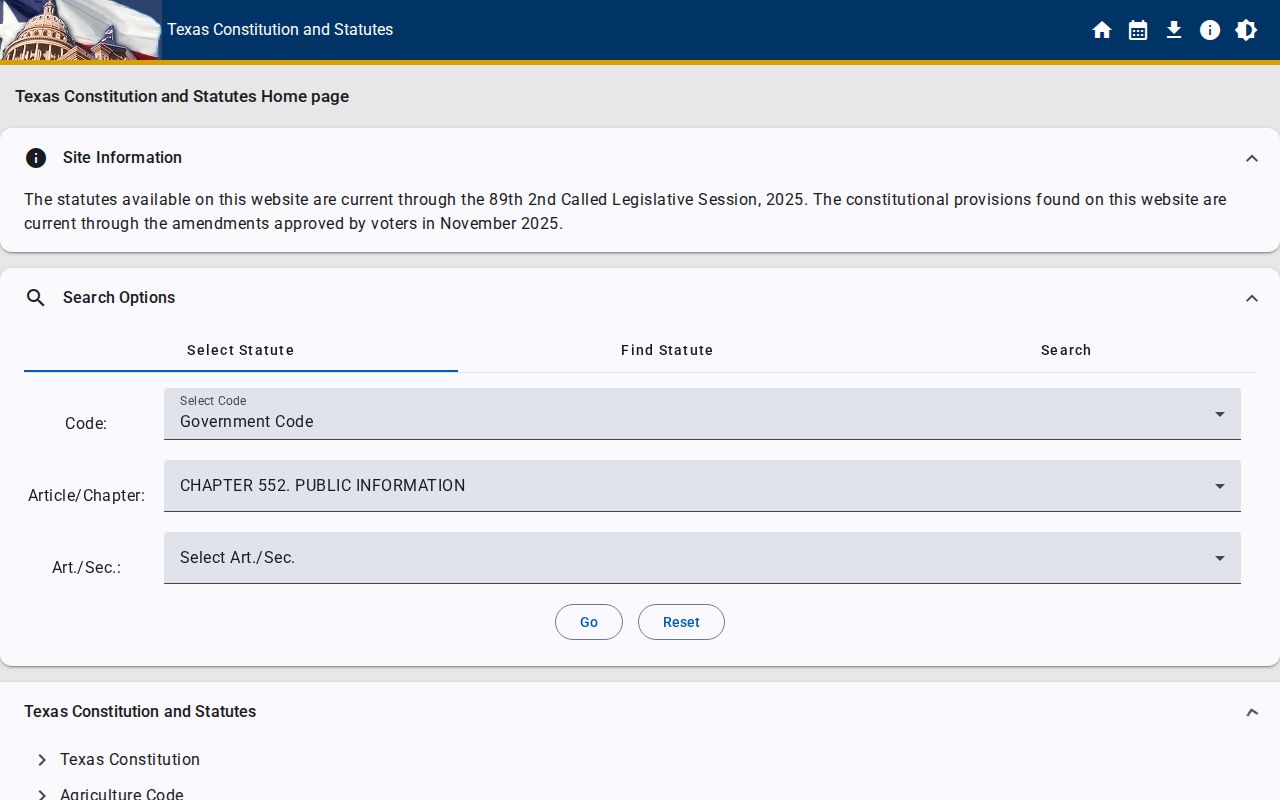
The statute image supports the records-request route, not the existence of a public 72-hour release feed.
Nacogdoches Roster Transfer Caveat
The current roster and aggregate counts refresh hourly, yet they offer no named 72-hour archive. County financial reports document out-of-county inmate housing during repair and high-population pressure. A name that drops from the Nacogdoches list may therefore reflect contract housing or transfer, not community release.
When the county record names TDCJ, search the state offender system after intake processing. For another county, contact the receiving jail. A TDCJ projected or scheduled date is not an accomplished release. VINE's transferred label also means custody continued elsewhere.
| Evidence | What it proves |
|---|---|
| Current roster entry | The person is displayed in county custody now. |
| No roster entry | Nothing by itself; investigate departure and destination. |
| Sheriff release sheet | The documented county custody event and available type. |
| Receiving-agency record | Custody after a transfer. |
Read Nacogdoches Release Labels
A three-day record set can contain very different events. Bond is conditional departure from pretrial custody while the case remains pending. Time served may reflect jail credit applied to a sentence or fine. Sentence completion ends custody on that sentence, although another hold may still control. Dismissal concerns the case and does not prove the jail completed release at the same moment.
Transfer means custody continues. It can point to TDCJ, another county, an out-of-county bed, USMS, or ICE. A writ can be a temporary move for court. Escape and death change the roster population but are not releases. Ask for the exact local label and destination rather than assigning a likely reason from the timing.
VINE uses source-reported event terms. A released event can corroborate departure from a participating facility, but it may not explain bond versus sentence completion. A transferred event expressly calls for follow-up with the receiving system. The court file and sheriff sheet answer different parts of the same event.
Nacogdoches Court Release Evidence
Route court research by charge level. District courts and the District Clerk generally hold felony matters. The County Court at Law and County Clerk handle county misdemeanors, while justice and municipal courts handle matters in their jurisdiction. The linked publicsearch.us portal is for real-property and official-record instruments; it was not verified as a criminal docket search.
Ask the proper clerk for a docket sheet and specific records such as the bond order, conditions, dismissal, judgment, sentence, jail-credit calculation, or order of release. A signed order has more value than a loose web reference. Still, the court record usually does not give the exact time the jail completed processing. Reconcile it with the sheriff custody event.
For one person, identifiers sharply reduce mismatches. For a request covering every release in 72 hours, expect the office to review costs, privacy limits, and law-enforcement exceptions. Narrow the fields to the records needed and accept segregable public portions.
Keep Nacogdoches Release Evidence Fresh
No released-name retention period was found for the sheriff website. The Texas Public Information Act governs access to records while held, but does not create permanent retention. State and local schedules, holds, expunction orders, and other rules can affect what remains. Request a three-day record set promptly and ask which record series applies.
Web copies can last longer than the official display and be less accurate. Save the source and capture time for any roster clue, then verify the named event with the origin office. A no-result can stem from spelling, identifier mismatch, lag, restriction, retention, or error. It cannot identify which cause applies.
The right follow-up also depends on custody. TDCJ covers a state transfer, BOP covers a federal sentenced prisoner, and ICE ODLS focuses on current immigration detention. County probation belongs with Nacogdoches CSCD; state parole belongs with TDCJ. None is a substitute for the county release sheet.
If BOP shows a past release date and no facility, that means no longer in BOP custody, not freedom from every authority. An ICE no-result likewise proves no release. Follow the agency named in the county transfer record and keep each system's status within its stated scope.
Preserve identifiers throughout the three-day review. A booking number ties the sheriff photo, custody history, and release sheet to one event. A court cause number links the order or judgment. TDCJ, BOP, and immigration identifiers serve their own systems. Names alone create needless risk of a false match.
Finally, record the date on which each source was checked. Roster data and agency events change, while a signed order or supplied custody record is more durable. A dated research trail makes later verification possible without claiming that an old screenshot still reflects current custody.