
Nacogdoches Projected and Actual Release
TDCJ defines Projected Release Date as the date its Classification and Records division projects release from incarceration if parole does not happen sooner. It is a calculation, not a completed event. Offense title, offense date, sentence, applicable credits, mandatory-supervision eligibility, and parole action can all matter. The Maximum Sentence Date is another milestone. It reflects sentence expiration, but it is not always the day a person walks out.
A Scheduled Release Date and Scheduled Release Location may appear after TDCJ receives a release certificate and completes further processing. TDCJ warns that both can change without notice, even on the scheduled day. An actual release date is the accomplished custody event. Discharge is later or different when supervision continues after physical release.
Find Nacogdoches Projected Release Dates
Choose the system by custody type. The TDCJ online inmate search is for people currently incarcerated in a TDCJ facility. It can show offense, sentence, location, projected release date, parole eligibility date, and maximum sentence information. It does not cover an ordinary Nacogdoches County Jail bond release.
- Check the Nacogdoches sheriff roster only to learn whether the person is presently displayed in county custody. A pretrial detainee may have no fixed release date.
- For a state prisoner, search TDCJ by TDCJ number or SID number when known. Otherwise use the exact last name, first name or initial, and available identifiers.
- Open the matching detail. Read Projected Release Date, Parole Eligibility Date, Maximum Sentence Date, and any Scheduled Release fields as separate milestones.
- If the online search fails, use TDCJ inmate-information email guidance. Supply the full name and TDCJ number, or exact date of birth or approximate age and county of conviction.
- For a local sentence, contact the jail records route and the sentencing court. Ask for the commitment, sentence, jail-credit entry, holds, and release event rather than requesting an unsupported estimate.
- Confirm an accomplished release with TDCJ, the sheriff custody record, or the receiving agency.
The Nacogdoches County release-record process explains how to distinguish a community release from a transfer after the person leaves the county roster.
Texas Credits and Nacogdoches Release Dates
The TDCJ definitions page documents the projected-release terms shown below.
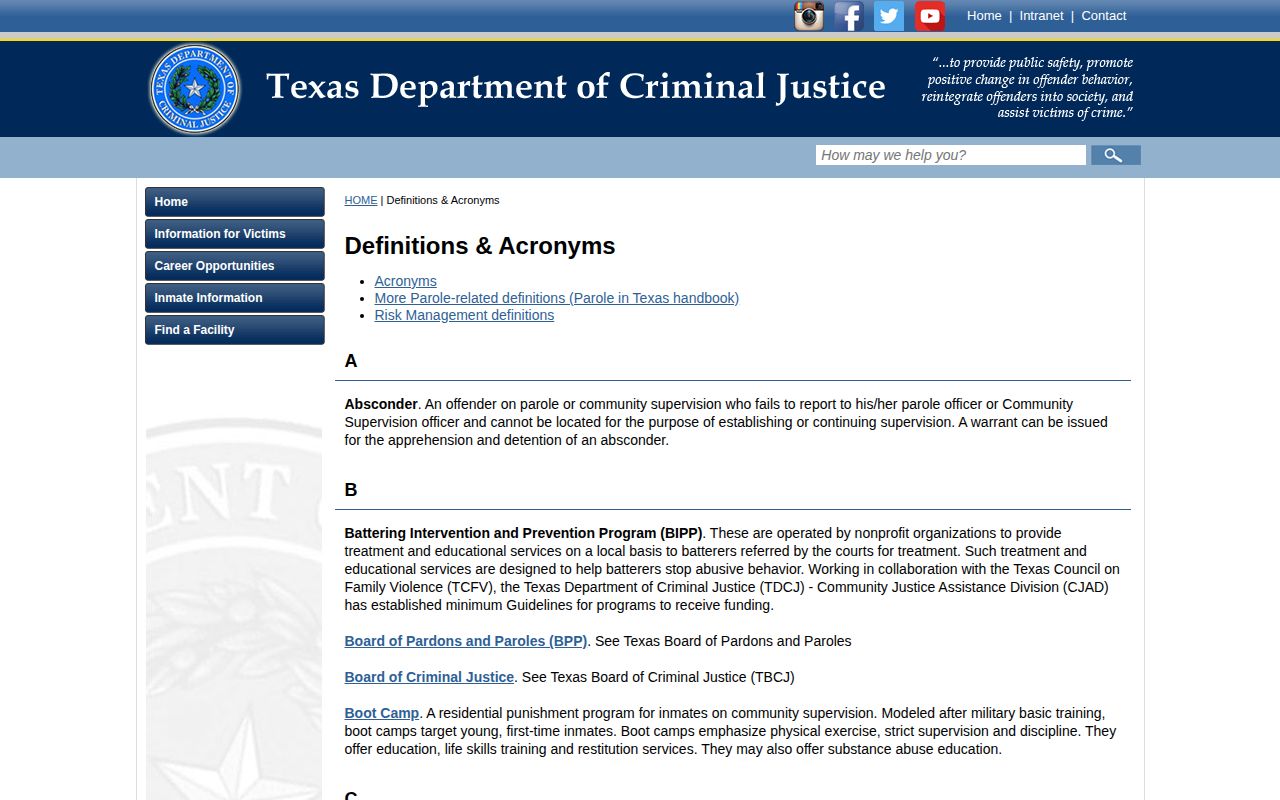
The official wording separates a projection from a scheduled or accomplished release.
Texas Government Code Chapter 498 controls TDCJ classification and good-conduct time. Good time is a privilege used in the ways state law permits. It does not cut down the sentence imposed by the judge. Credit may affect eligibility or the projected calculation, and disciplinary action can cause forfeiture under the governing rules.
Parole eligibility is offense-specific under Government Code Chapter 508. Texas does not impose one blanket rule that all prisoners serve 85 percent. Certain serious-offense provisions instead require actual calendar time equal to one-half of the sentence or 30 years, whichever is less, and good time does not count toward that threshold. Other offenses, dates, findings, and sentence structures follow different rules.
For an eligible mandatory-supervision case before September 1, 1996, flat time plus good time can drive the calculation. For an eligible case on or after that date, Board of Pardons and Paroles approval for discretionary mandatory supervision also matters. A denial can move the projection to maximum expiration or discharge; later approval can move it earlier. A noneligible case generally projects to maximum expiration using flat time unless parole occurs first.
Note: A valid computation needs the exact conviction, offense date, sentence, jail credit, disciplinary status, eligibility rules, holds, and current official action.
Why Nacogdoches Release Dates Change
A changed date does not always indicate an error. TDCJ recalculates when the legal or factual inputs change. The correct response is to identify the altered field or decision, not to rely on an older screenshot.
| Factor | Possible effect |
|---|---|
| Parole decision | Release may occur before the projected incarceration end, but approval is not the physical event. |
| Mandatory-supervision review | Approval or denial can move an eligible post-1996 projection. |
| Good-time forfeiture or restoration | Changes credits used where law allows them in the calculation. |
| Detainer or hold | May route the person to another authority instead of the community. |
| Court order or sentence correction | Can change the controlling sentence, credit, or authority. |
| Release processing | Audit, certificate, plan, location, and scheduling work can alter a scheduled date. |
A county-jail roster disappearance poses a different problem. It may reflect bond, time served, transfer to TDCJ, transfer to another jail, a writ, or another event. The sheriff release sheet is needed to label that departure.
Confirm Nacogdoches Release Dates
For a TDCJ release, distinguish three sources. The legacy inmate search shows current state confinement and projected fields. TDCJ IVSS covers people in custody or on parole or mandatory supervision and may show an actual release date, on-supervision status, and assigned parole office. TDCJ records, email, and telephone channels fill gaps in an older discharge history.
For a Nacogdoches County Jail departure, request the specified booking's release sheet or custody-event record from the Sheriff's Office. Ask for booking number, admission and departure date and time, release type, authority, and destination or receiving agency when applicable. Pair it with a court order when the legal reason matters. The court can show bond, dismissal, judgment, sentence, or jail credit, but it may not show the physical walk-out time.
A Nacogdoches VINELink inmate search can provide an event alert from a participating source. Read “released” and “transferred” as different events. Confirm a high-stakes timing decision through the agency that controls the record.
Telephone channels can help identify the stage. TDCJ lists separate routes for general inmate location, Board review status, and release processing after favorable action. A caller should have the TDCJ or SID number. Without it, exact birth information may be required. Ask whether the answer concerns review, approval, scheduled processing, actual release, or current supervision. A date given for one stage should not be relabeled as another.
Sentence structure adds another layer. Concurrent sentences run together under their legal terms, while consecutive sentences may create a longer combined framework. Jail credit, affirmative findings, offense-specific exclusions, and the law in force for the offense date can change eligibility. A simple percentage calculator cannot safely account for those facts. The official record and current statute control.
TDCJ Release Processing Milestones
TDCJ's ombudsman describes an additional process after Classification and Records receives a release certificate. Staff audit and calculate the scheduled release, with an approximate processing description of 14 to 21 business days, while noting that each case varies. The website may then display a scheduled date and location.
That time description is not a promise for a named person. A release plan, detainer, certificate, audit issue, or other case fact may change the outcome. The parole review-status line, release-status line after a favorable vote, and inmate locator lines answer different stages. Review eligibility, favorable action, scheduling, physical release, supervision, and final discharge should never be collapsed into one date.
Federal dates also use a separate source. The Bureau of Prisons locator can show a future projected release date or a past release date. A past date with no facility, or a location labeled RELEASED, means the person is no longer in BOP custody. It does not rule out supervision, state or local custody, or immigration custody. ICE location results likewise cannot be converted into a historic release ledger.
For a Nacogdoches case that moved between systems, build a timeline from records rather than merging portal fields. Use the county transfer event, receiving-agency intake, sentence and credit data, later scheduled fields, and the accomplished release event. This approach reveals whether an apparent date conflict is actually two agencies describing different stages.
Nacogdoches Jail Sentence Calculations
County jail sentence credit follows the sentence, applicable Texas criminal procedure, and the sheriff's administered records. Code of Criminal Procedure article 42.032 addresses county-jail credit, but no published Nacogdoches County good-time formula was verified. Do not import the TDCJ calculation into a local jail term.
Nacogdoches JP1 publishes a “Request Time Served” route limited to people who have been in the Nacogdoches jail. That entry can support a court's treatment of jail credit. It is not the sheriff's actual release timestamp. For a reliable local answer, obtain the judgment or order, jail-credit entry, sheriff custody history, and information on any other hold.
A pretrial detainee is different again. Bond, dismissal, a court order, or another authority can determine departure, so there may be no sentence-based projected date at all.