
Nacogdoches Parole and Probation Compared
Parole and probation are not two names for the same status. Texas parole follows confinement in the state prison system. The TDCJ Parole Division supervises the person in the community under terms tied to the remaining sentence. Mandatory supervision is another form of supervised release from TDCJ. Probation, formally called community supervision in Texas, comes from a court and is managed locally by the Nacogdoches County Community Supervision and Corrections Department, or CSCD.
A person can be outside custody without being on either one. Bond releases a defendant while a case is pending. A completed sentence may end with discharge and no supervision. Conversely, probation may be ordered without a prison stay. Confirm the legal status instead of drawing it from where the person was last held.
| Question | Parole or mandatory supervision | Probation |
|---|---|---|
| Who orders or administers it? | Texas parole authorities and TDCJ | The sentencing county or district court and CSCD |
| What custody usually came first? | TDCJ state incarceration | May follow county jail, or may replace confinement |
| Where to verify | TDCJ, IVSS, BPP, then the district parole office | CSCD and the sentencing court record |
| How it ends | Discharge, revocation, or other official action | Court completion, discharge, extension, or revocation |
- Parole
- Conditional community release from a state prison sentence.
- Probation
- Court-ordered community supervision administered by the local CSCD.
- Discharge
- The formal end of custody or supervision authority, not merely physical release.
- Absconder
- A person alleged to have stopped reporting or left supervision without permission; verify the current official status.
Verify Nacogdoches Post-Release Supervision
Start with the sentence source. A Nacogdoches County conviction alone does not tell where a person was confined or supervised. TDCJ can place a state prisoner anywhere in Texas, and the local parole office serves more than one county. The county jail roster only reports current local custody. Use identifiers such as the TDCJ number, state identification number, booking number, exact date of birth, and court case number to avoid a same-name error.
The TDCJ county cross-reference is shown below.
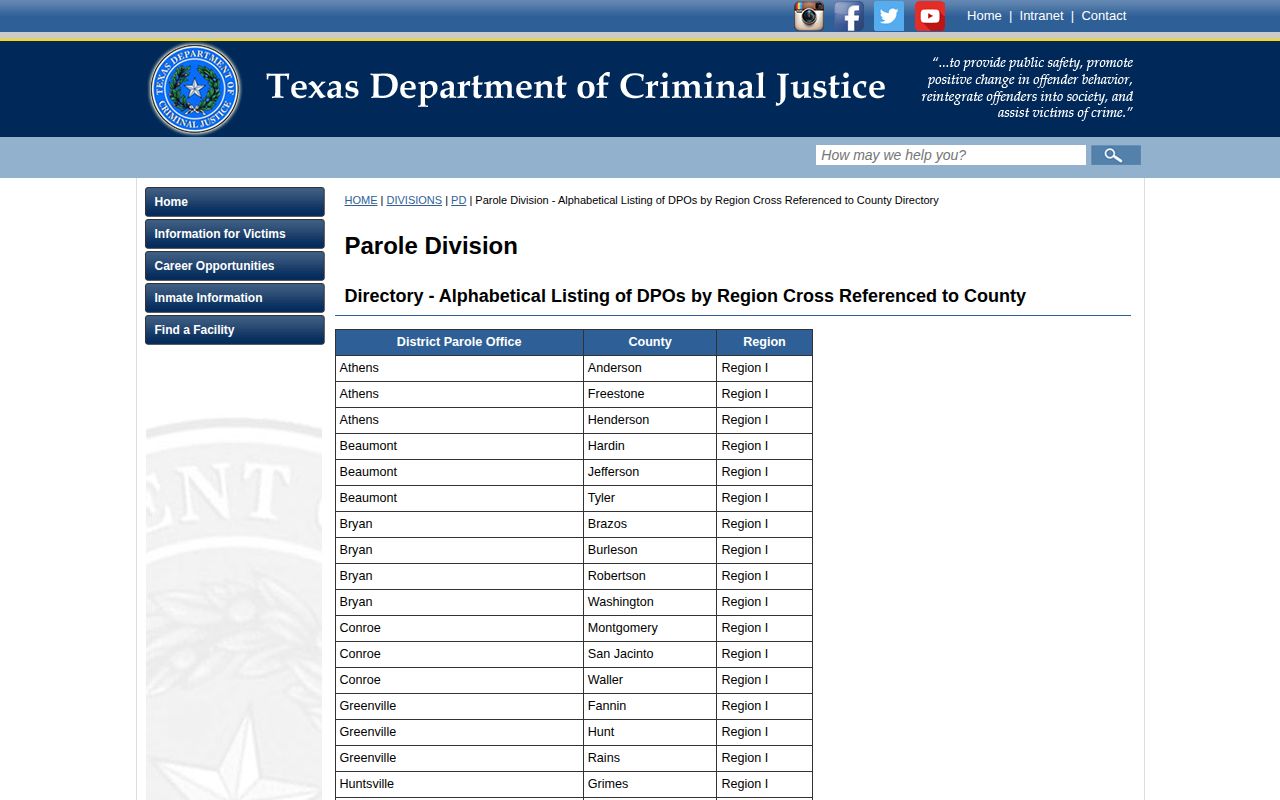
The directory routes state parole questions to the district office rather than county probation.
- Check the TDCJ inmate search if the person may still be in state prison. A current prison result is not a release record.
- Use TDCJ IVSS for a person who may be released on parole or mandatory supervision. Read the status, actual release date, and parole-office field.
- For parole review, use the Board of Pardons and Paroles review process and official status channels. Eligibility or a favorable vote is not physical release.
- For probation, contact Nacogdoches County CSCD and check the sentencing court record. CSCD is not a public archive of all released jail detainees.
- Ask the assigned office to confirm the correct record route when an online result is unclear. Do not infer supervision from a roster absence or old web entry.
Nacogdoches Supervision Office Routes
Use the office that matches the order. The TDCJ Region I directory assigns Nacogdoches County parole matters to the Nacogdoches District Parole Office. The county's CSCD contact page handles local court community supervision. An office assignment can change, so confirm through the current directory before relying on an address.
Nacogdoches District Parole Office
1113 Industrial Boulevard
Nacogdoches, TX 75964
Phone: 936-569-6234
Fax: 936-560-2716
Serves Nacogdoches, Angelina, Sabine, and San Augustine counties.
Nacogdoches County CSCD
206 West Pilar
Nacogdoches, TX 75961
Phone: 936-560-7715
Monday through Friday, 7 a.m. to 6 p.m.
The CSCD mail-report form asks assigned clients for such details as the supervising officer, last and next visit, community-service progress, and alleged violations. Those fields illustrate local case management. They do not create a public person-search tool.
Nacogdoches Supervision Status Changes
Conditions vary by the judgment, parole certificate, and individual plan. They can concern reporting, approved residence, travel, treatment, fees, or contact restrictions. Only the controlling order and supervising agency can state the actual terms. A claimed violation may lead to review, a warrant, or custody, but an allegation does not by itself prove revocation.
A “blue warrant” is a Texas parole-revocation warrant. The Nacogdoches jail statistics include a blue-warrant population category, which means some people held there face alleged parole violations. It does not mean they were newly convicted. Texas VINE may relay a participating custody change, but it does not decide parole or probation status. Court, BPP, TDCJ, and supervision records supply that authority.
A supervision check should also preserve the date and scope of each source. A court docket may record probation action while TDCJ records state parole, and neither source is a substitute for the other. When names match but identifiers do not, stop and resolve the identity before contacting an office. Staff can best route a focused question that cites a case number, TDCJ or SID number, and the specific status field at issue. General questions about whether someone is “free” can hide the key distinction between physical release, active supervision, a pending warrant, and final discharge.
Nacogdoches Supervision and Discharge
Physical release and final discharge are separate milestones. A person on parole or mandatory supervision has left prison but remains under TDCJ authority. Probation likewise keeps a person under a court order while living in the community. The status ends only through the action authorized for that case, such as completion and discharge, a court order, or revocation.
For a historic TDCJ status that no longer appears online, request the appropriate incarceration or release history. TDCJ accepts inmate-information requests at its official information channel. The request should include the full name and seven-digit TDCJ number, or the exact date of birth or approximate age and county of conviction when the number is unknown. For county probation, obtain the relevant CSCD or court record.
The broader Nacogdoches County released-inmate search explains how a jail release sheet, court order, and receiving-agency record fit together. Those records should be reconciled when the question involves both release from custody and later supervision.
Nacogdoches Parole Counseling Route
TDCJ lists the Alcohol & Drug Abuse Council of Deep East Texas as a contracted Parole Division outpatient provider at 1407 North University Drive, Suite B-2, Nacogdoches. The state listing identifies five contracted slots. That is a service-navigation fact, not a promise that any person qualifies, has an opening, or can enroll without referral.
People under parole supervision should use their assigned officer and approved plan when seeking services. County probation clients should follow CSCD instructions instead. The two systems may use some of the same community providers, but their authority, referrals, and records remain separate.
Verify Nacogdoches Warrant Status
The sheriff's Most Wanted page warns that its information was current when published and must be verified. A retained entry marked captured demonstrates the risk of treating an old web appearance as a live warrant or absconder finding.
Confirm a warrant through the issuing authority. Do not use a photograph, a past listing, or silence from a search as proof. If immediate safety is involved, contact law enforcement and do not attempt an apprehension. For an alleged parole violation, TDCJ and the warrant authority are the proper sources; for probation, use CSCD and the court.
Note: Web status can lag the official case, so record the source date and verify the current supervision or warrant status directly.